


Original field research · July 2026
2026 Senior Living Inquiry-to-Tour Benchmark: 100 Communities
Quid research across 100 senior living website journeys shows where inquiry-to-tour coordination pauses and where automation is visible.
28 operator groups
Data, sources and methodology
Direct answer
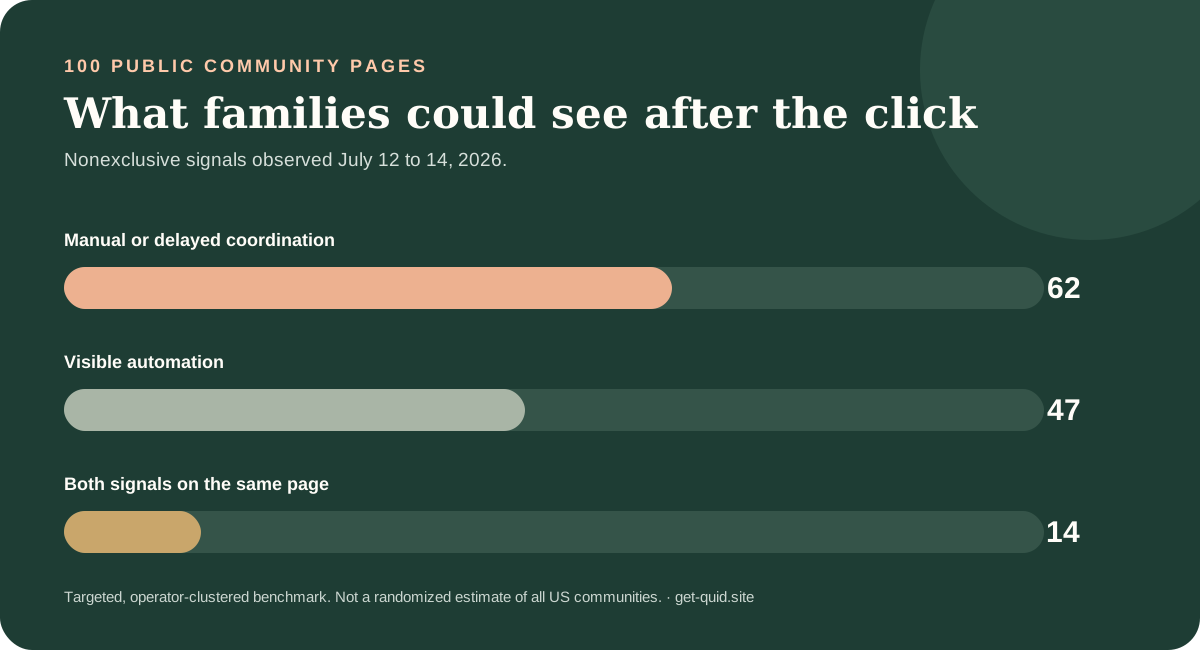
Quid reviewed 100 public senior living community website journeys across 28 operator groups and 23 states. Sixty-two pages exposed a manual or delayed-coordination signal, 47 exposed automation, and 14 showed both. This is a purposive, operator-clustered benchmark, not a randomized national prevalence study.
Quid reviewed 100 public senior living community website journeys across 28 operator groups and 23 US states on July 12 to 14, 2026. We followed only what a family could see without submitting a form. We did not pose as a family, test response times, or inspect any operator’s CRM, inbox, staffing, conversion rate, or resident data.
The benchmark shows two realities at once. Many websites still place a manual step between a high-intent visitor and a confirmed visit. Larger operator templates more often expose preferred-time forms or embedded inquiry assistants, but automation and staff follow-up frequently appear together.
Direct answer: what happens after a senior living tour CTA?
In this purposive 100-page benchmark, 62 community journeys exposed a manual or delayed-coordination signal. Examples included a form that did not visibly reserve the requested time, a preferred-date request, or language indicating that staff would arrange or confirm the next step.
At the same time, 47 community pages exposed an automation signal, usually an embedded inquiry assistant. These findings overlap: 14 pages showed both automation and a visible staff-follow-up or preferred-time step.
The practical conclusion is not that every manual signal means a slow team, or that every script means a completed booking. It is that the words “Schedule a Tour” do not reveal what happens next. Operators should test the entire visible journey: acknowledgement, real availability, confirmation, staff ownership, human handoff, and stalled-work visibility.
Most quotable finding
62 of 100 reviewed senior living pages still exposed a manual or delayed step somewhere in the public inquiry-to-tour journey.
This is a targeted, operator-clustered website benchmark, not a randomized estimate of all US communities.
Two cohorts tell a more useful story
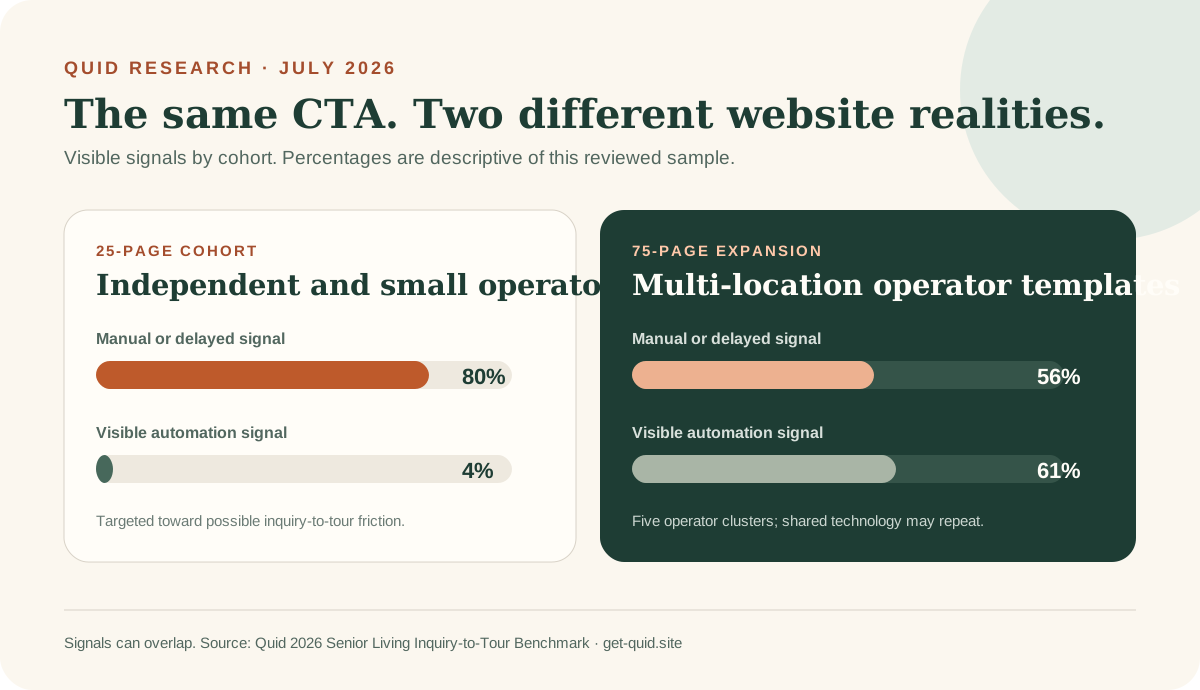
The first 25 pages came from Quid’s small-operator outreach research. The 75-page expansion came from five multi-location operator clusters selected from official public sitemaps. Because pages from the same operator may share technology and design, the cohorts should be read separately as well as together.
| Cohort | Pages | Manual or delayed signal | Automation signal | How to interpret it |
|---|---|---|---|---|
| Independent and small-operator research | 25 | 20 of 25 · 80% | 1 of 25 · 4% | Targeted toward possible inquiry-to-tour friction. |
| Multi-location template expansion | 75 | 42 of 75 · 56% | 46 of 75 · 61% | Five operator clusters; shared technology can repeat across pages. |
| Combined benchmark | 100 | 62 of 100 · 62% | 47 of 100 · 47% | Descriptive of this reviewed sample, not national prevalence. |
The contrast matters. The smaller-operator cohort exposed more forms and staff-arranged steps. The multi-location expansion exposed substantially more embedded automation, yet more than half of those pages still showed some visible coordination step that did not look like an immediate, confirmed booking.
Five visible journey patterns
We classified what the public page made visible, not what may happen behind the scenes.
Form and staff-arranged
The visitor provides information. A person or team handles the next step later.
Time requested, not reserved
The page accepts a preferred date or time but does not visibly show a confirmed booking.
Embedded inquiry assistant
An automated assistant is exposed in the journey and can continue the conversation.
Automation plus staff follow-up
An assistant is present, but the page also tells the visitor that an associate will contact them.
Immediate scheduling visible
The visitor can see availability, choose a supported time, and understand how confirmation happens.
What the public journey can and cannot prove
A website can show friction without proving poor internal performance. A community may route its form into an excellent CRM, respond within minutes, and coordinate tours reliably. Likewise, the presence of an automated assistant does not prove that a tour was booked, that the system integrates with the operator’s record system, or that every conversation is handled appropriately.
This benchmark therefore uses restrained language:
- Manual or delayed signal means the public journey visibly leaves coordination, confirmation, or follow-up for a later step.
- Automation signal means the page exposes an embedded automated inquiry experience or a clearly automated tour journey.
- Both means automation is present while the visitor still sees staff follow-up or another non-final step.
- Unknown means the public page does not provide enough evidence for a confident classification.
The benchmark does not measure reply speed, lead quality, tour attendance, move-ins, occupancy, revenue, staffing competence, or clinical care.
The revenue problem in plain words
Families may contact more than one community. Every unnecessary pause between inquiry and a clear next step gives another community an opening. The fix is not “remove the admissions team.” The fix is to stop making staff recreate predictable coordination by hand.
A controlled workflow should acknowledge the request, expose only approved tour availability, confirm the selected visit, notify the staff owner, pause for sensitive questions, and show managers what is still stuck. See the assisted living admissions automation workflow and the senior living tour scheduling guide.
Methodology
Sample construction
This July 2026 edition combines two purposive cohorts:
- 25 independent and small-operator pages previously evaluated during Quid’s outreach research on July 12 and 13. These rows emphasize independent communities and operators with roughly one to 10 locations. Community and staff identities remain anonymized in the public row-level file.
- 75 multi-location pages reviewed on July 14. We selected 15 community pages from each of five operator clusters using official public sitemaps: Brookdale, Sunrise Senior Living, Benchmark Senior Living, Merrill Gardens, and Leisure Care.
All 75 named expansion URLs returned a public page during review. The source register includes the page title, state, classification, review date, and exact URL.
Review protocol
- Unit of analysis: one public community page and its visible inquiry or tour controls.
- Geography: 23 US states across the combined sample.
- Operator clustering: 100 pages represent 28 operator groups; one shared template may affect multiple rows.
- Evidence captured: CTA category, visible journey category, manual/delayed signal, automation signal, state, operator-size band, and review date.
- Safety: no form submission, impersonation, resident information, medical information, email collection, or private-system access.
- Quality control: every expansion URL was fetched successfully and classified from its public HTML on July 14, 2026.
Limitations
This is not a probability sample and must not be cited as the share of all US senior living communities. The original cohort intentionally emphasized possible workflow gaps. The expansion intentionally sampled multiple pages from five large operators, so repeated templates are part of the observation. Public HTML can expose scripts and form language but cannot prove implementation quality, availability, response time, integration, or conversion performance.
The benchmark will retain this URL. Future editions will publish the new denominator, dates, operator mix, methodology changes, and archived downloads rather than silently changing the findings.
Download, verify, and cite the benchmark
Four-page benchmark brief
Key findings, cohort comparison, visible journey patterns, methodology, and citation language.
Download PDFAll 100 anonymized rows
Operator groups are coded so the clustered design remains visible without identifying the first 25 outreach prospects.
Download CSV75 named expansion pages
Exact public page URLs, titles, states, review dates, and classifications for independent verification.
Download source registerPress and podcast brief
A concise summary, approved statistics, methodology note, and contact information.
Download media briefSuggested citation:
Quid Research. “2026 Senior Living Inquiry-to-Tour Benchmark: 100 Communities.” Quid Admissions, July 14, 2026. https://get-quid.site/resources/senior-living-inquiry-to-tour-audit/
When citing the 62% or 47% findings, describe them as shares of this purposive, operator-clustered 100-page benchmark, not the entire US senior living market.
Embeddable charts
Publishers may embed the charts below with attribution and a link to this methodology page.
<a href="https://get-quid.site/resources/senior-living-inquiry-to-tour-audit/">
  <img src="https://get-quid.site/research/benchmark-2026-cohort-comparison.svg"
       alt="Quid 2026 senior living inquiry-to-tour benchmark cohort comparison">
</a><a href="https://get-quid.site/resources/senior-living-inquiry-to-tour-audit/">
<img src="https://get-quid.site/research/benchmark-2026-visible-signals.svg"
alt="Visible inquiry-to-tour signals across 100 reviewed senior living pages">
</a>What senior living teams can check today
Open your own website on a phone and follow the journey without using staff knowledge to fill in the gaps.
- Does the family know the request arrived?
- Are they choosing a supported time or merely requesting one?
- Is the visit visibly confirmed?
- Who owns the next step?
- What happens after hours?
- Does automation pause when the family replies or asks a sensitive question?
- Can a manager see tomorrow which inquiries are still stuck?
Use Quid’s human-handoff checklist, senior living follow-up templates, and workflow overview to review the process.
Frequently asked questions
What did the 2026 senior living inquiry-to-tour benchmark find?
Quid reviewed 100 public community website journeys across 28 operator groups and 23 states. Sixty-two pages exposed a manual or delayed-coordination signal, 47 exposed automation, and 14 showed both.
Does this mean 62% of all senior living communities have manual tour scheduling?
No. The benchmark is a purposive, operator-clustered sample. The original 25 pages emphasized independent and small operators with possible friction, while the 75-page expansion sampled 15 pages from each of five multi-location operators. The percentages describe the reviewed pages, not the entire US market.
How did Quid review the community websites?
Quid followed only the public website journey visible to a family. No forms were submitted, nobody posed as a family, and no resident, medical, or private information was collected.
What counts as a manual or delayed coordination signal?
Examples include a form without visible tour availability, a promise that staff will arrange the visit later, a tour request routed into a general contact form, or a tour form that is not accepting responses.
Can I download and verify the benchmark data?
Yes. Quid publishes all 100 anonymized rows plus a separate source register with the exact public URLs and classifications for the 75-page expansion. The first 25 outreach-research rows remain anonymized.
Related senior living admissions guides
How to Increase Assisted Living Occupancy: Fix the Inquiry-to-Tour Gap
Nine practical ways assisted living operators can improve occupancy by converting more existing inquiries into tours without adding more lead spend first.
Read How to Increase Assisted Living Occupancy: Fix the Inquiry-to-Tour GapSenior Living Inquiry-to-Tour Automation: What to Automate and Keep Human
Decide which senior living inquiry and tour tasks to automate, which require staff, and how to keep speed-to-lead work controlled.
Read Senior Living Inquiry-to-Tour Automation: What to Automate and Keep Human7 Best Senior Living Admissions Tools for Inquiry Follow-Up (2026)
Compare seven senior living tools for inquiry response, tour scheduling, follow-up, CRM management and human handoffs.
Read 7 Best Senior Living Admissions Tools for Inquiry Follow-Up (2026)30-Day Quid Admissions Pilot
Start with one community and one workflow.
The pilot gives your team a focused way to test inquiry follow-up and tour coordination around the tools you already use.
Clear scope from day one
- One community
- One website inquiry source
- One staff-controlled tour calendar
- Approved messages and timing
- Human handoff rules
- Optional continuation after 30 days
Focused 30-day implementation
30-Day Quid Admissions Pilot

$1,000one-time
One community, one inquiry source, and one tour calendar.
Keep Quid for $899/month per community after the pilot.
Included
- Current workflow review
- Approved response and follow-up flow
- Human-handoff rules
- Controlled implementation
- Optional manager and exception view
- Daily admissions summary
- Monitoring and tuning
- End-of-pilot report